



The evaluation trade-off
Recorded traces are easy to replay but hard to scale to all valid routes.
A single trace records one way to complete a task. A user might find a product by searching for it, browsing a category, or applying filters in a different order. An evaluation that matches an agent’s actions against one reference trace can mark a valid attempt as a failure. A state-transition graph built from recorded interactions can cover more routes, but the number of combinations grows combinatorially as text inputs, filters, product options, and intermediate screens interact. Each additional branch requires more interactions to record and validate, making broad coverage impractical for complex workflows.
Live commercial apps let agents explore, but make outcomes harder to verify and experiments harder to repeat.
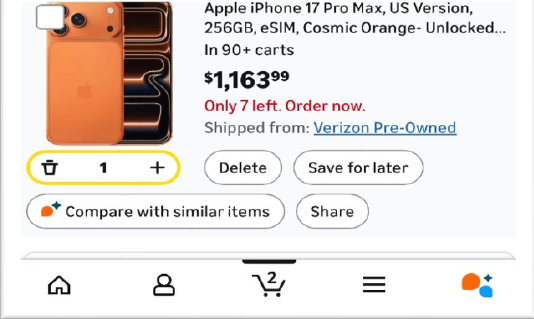
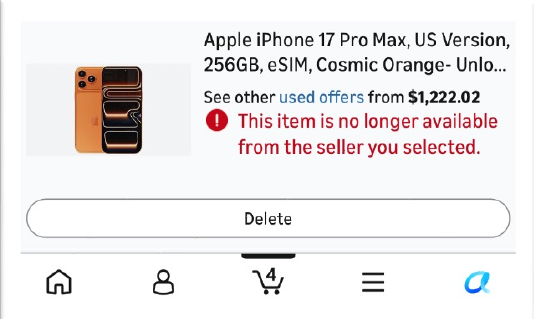
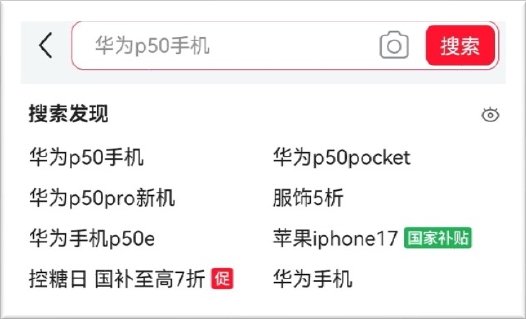
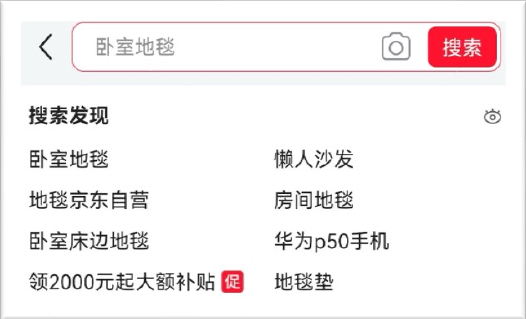
Evaluators usually lack access to the service’s backend state, so they often use an LLM to infer success from screenshots or interaction histories. A confirmation screen might show that an order was placed while omitting the selected delivery address. The judge has to infer whether the full request was satisfied, and incomplete evidence can produce an incorrect success label. Platform controls such as CAPTCHAs, verification codes, and rate limits can also interrupt runs, require manual intervention, and slow down large evaluations. Meanwhile, changes in inventory, search suggestions, and account history can give agents different conditions for the same task.
Same instruction, changing conditions
Environment 1
Environment 2
Environment 1
Environment 2
AppSim-Bench recreates everyday commercial-app workflows in a controlled environment.
We built AppSim-Bench with researchers at Central China Normal University. The simulators reproduce the screens, controls, and navigation needed for those workflows and support multiple valid routes. Each attempt starts from the same task-specific app state and data. The evaluator checks the recorded state change, the agent’s answer against a predefined result, or both, depending on the task. This lets us compare agents on the same workflows and verify whether they achieved the requested outcome.
Where evaluation settings make trade-offs
Live appsHard to control state
Static datasetsCostly route coverage
Open-source appsLimited commercial task mix
Building apps we can reset
17 apps across two ecosystems
The suite contains nine Chinese app environments with 283 tasks and eight English app environments with 274 tasks. They cover communication, shopping, food delivery, travel, navigation, video, music, and meetings, including WeChat, JD, Amap, Amazon, Uber Eats, and Booking.com. Ordering lunch with an extra topping or finding yesterday’s file in a group chat turns a short request into several actions that the agent has to keep track of.
We rebuild the pages and interactions needed for those tasks around predefined data. A product page has to connect to the right cart. Placing an order has to be recorded correctly. Leaving a page and returning to it has to preserve the relevant state. We specify these relationships in the data schemas and page hierarchy, then check that the controls and recorded outcomes agree.
Getting the state changes right
Researchers first recorded common usage scenarios and turned them into task instructions. They defined the entity classes and backend fields, chose the task-relevant pages, and mapped their navigation tree. Reference screenshots and interaction requirements guided the coding agents. Developers and independent reviewers then ran successful attempts and deliberate failures, checking both app behavior and the evaluator’s scores.
In the Uber Eats simulator, reviewers fixed store entry points, cart quantities and images, and the return path after adding an item. These corrections keep navigation and cart contents consistent as the agent moves between pages. The construction log records 23 review-and-correction rounds across ten pages.
Construction workflow and page transitions
From usage scenarios to verified outcomes
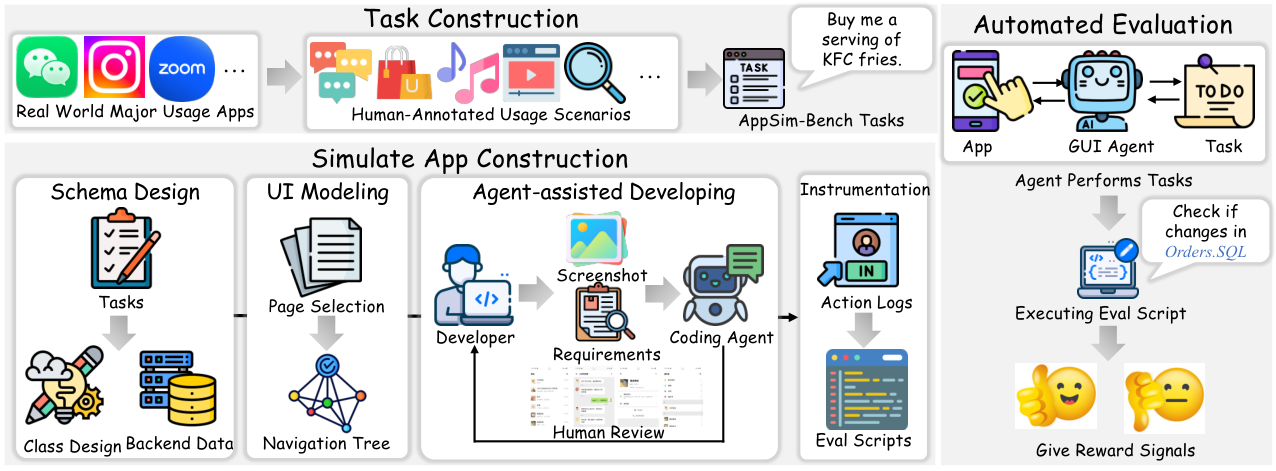
Swipe to explore the full diagram.
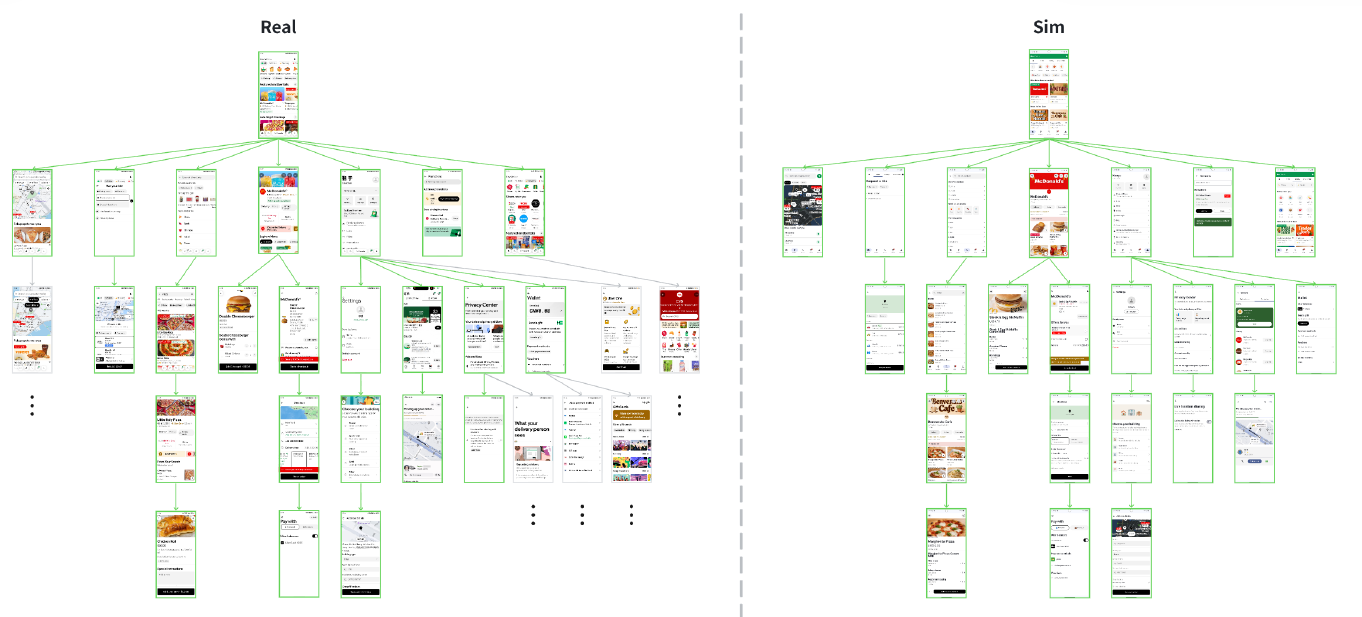
Green marks task-relevant pages retained in the simulator. Paper, Fig. 7
Can people tell the interfaces apart?
Seven annotators conducted a blind A/B study over 11 sessions to see how easily people could tell real and simulated interfaces apart. They compared matched screenshots or sequences of screenshots from continuous interactions, identified the real interface, or answered “undecided.” The study tests appearance; we check task behavior by running the interactions and inspecting their outcomes.
Reviewers were undecided in 46.3% of the 510 screenshot judgments and 35.7% of the 255 sequence judgments. Among judgments with an explicit A/B choice, they chose the simulated interface as real in 19.0% of 274 screenshot judgments and 15.2% of 164 sequence judgments. The simulators retain task-relevant pages and transitions, including alternative routes through a task. Out-of-scope branches display a “page under development” message, marking where the simulator ends.
Interface study results
Can people tell the interfaces apart?
Single screenshot
Interaction sequence
Different routes, the same outcome
An agent can find an item through search, a category page, or its browsing history. Any of these routes is valid if it produces the requested result. We check that result in three ways.
State tasks check changes in the app, such as whether an order was placed or a message was sent to the right conversation. Answer tasks check a structured response, such as an item’s name and price. Hybrid tasks require both.
Each app records task-relevant changes in structured logs or backend fields. The evaluator inspects those records, the agent’s answer, or both, and returns a binary result. When an agent answers in free-form text, a shared executor extracts the required fields before deterministic checks compare them with the task’s required result.
Evaluation setup and scoring
All evaluations run on Android 13 (API 33, 1080 × 1920) at temperature 0 with a 50-step budget. Each attempt starts from the task’s defined app state and data with a fresh agent history. Success is binary and checked against the required state change, structured answer, or both. For free-form responses, a shared reference executor extracts structured fields before deterministic scoring (with no LLM calls in the final scoring stage); a manual audit of all 3,933 answer and hybrid scoring cases found zero extraction errors (0/3,933). Of the 654 audited runs, 28 (4.28%) reached a “page under development” placeholder and still succeeded.
Roughly half the tasks remain unfinished
We evaluated 15 general-purpose agents and four GUI-specialized systems, each with a 50-step budget. The four highest-scoring systems complete between 49.6% and 50.3% of tasks. Even at the top of the leaderboard, roughly half the suite remains unfinished.
A shared gap in task completion
Overall success
Agents completing each task
Across all 19 agents, 159 tasks (28.55%) are never completed, while only two (0.36%) are completed by every agent. These shared failures give us a starting point for studying where execution breaks down.
In this evaluation, the best-performing GUI-specialized system completes 31.4% of tasks, compared with about 50% for the leading general-purpose systems.
Task coverage
How widely are tasks solved?
| Successful agents | Tasks | Share |
|---|---|---|
| 0 | 159 | 28.55% |
| 1 | 32 | 5.75% |
| 2 | 24 | 4.31% |
| 3 | 30 | 5.39% |
| 4 | 31 | 5.57% |
| 5 | 23 | 4.13% |
| 6 | 26 | 4.67% |
| 7 | 27 | 4.85% |
| 8 | 20 | 3.59% |
| 9 | 21 | 3.77% |
| Successful agents | Tasks | Share |
|---|---|---|
| 10 | 30 | 5.39% |
| 11 | 19 | 3.41% |
| 12 | 24 | 4.31% |
| 13 | 26 | 4.67% |
| 14 | 23 | 4.13% |
| 15 | 9 | 1.62% |
| 16 | 12 | 2.15% |
| 17 | 12 | 2.15% |
| 18 | 7 | 1.26% |
| 19 | 2 | 0.36% |
Where execution breaks down
We examine four places where execution can break down: keeping track of a long workflow, inspecting a complete list, using numerical information, and noticing when actions stop helping.
Keeping track across screens
We group tasks by the number of steps in their human reference solutions: at most five, six to ten, and at least eleven. Every agent performs worse on the longer groups. Of the 135 longest tasks, Gemini-3-Pro completes 33.33%. The groups contain different tasks and show which workloads are hardest for these agents.
Longer workflows are harder
All 19 agents by task length
| Agent | ≤5 steps | 6–10 steps | ≥11 steps |
|---|---|---|---|
| Claude-Opus-4.7 | 58.87% | 54.29% | 28.15% |
| Gemini-3-Pro | 56.38% | 52.86% | 33.33% |
| GPT-5.5 | 59.22% | 52.14% | 27.41% |
| Gemini-3.1-Pro | 56.74% | 52.86% | 31.11% |
| Doubao-Seed-1.6 | 45.74% | 43.57% | 20.74% |
| GPT-5 | 43.62% | 31.43% | 14.07% |
| Doubao-Seed-1.8 | 43.26% | 27.86% | 13.33% |
| Qwen-3.6-Plus | 39.01% | 31.43% | 15.56% |
| Doubao-Seed-2.0 | 37.94% | 28.57% | 11.85% |
| GPT-5.4 | 38.30% | 25.71% | 13.33% |
| Qwen-3.6-Flash | 38.30% | 25.71% | 9.63% |
| Claude-Sonnet-4.6 | 36.17% | 27.86% | 8.15% |
| Claude-Haiku-4.5 | 34.04% | 15.71% | 6.67% |
| Claude-Sonnet-4.5 | 31.91% | 14.29% | 5.19% |
| Gemini-2.5-Pro | 26.24% | 14.29% | 1.48% |
| MobileAgent-v3.5 | 41.49% | 26.43% | 15.56% |
| UI-TARS-1.5-7B | 30.14% | 22.86% | 6.67% |
| AgentCPM-GUI | 17.02% | 5.71% | 0.00% |
| V-Droid | 15.25% | 7.86% | 0.74% |
Longer workflows require an agent to keep track of the request and earlier observations as the screen changes. Ranking a cart makes that dependency concrete: a decision about the whole list requires inspecting the whole list.
Deciding before seeing the full list
AMAZON#21 asks an agent to find the three most expensive items in its cart and report their combined price. None of the 19 agents returns the expected total, 3,118.98. Every reported total is lower.
The top three depend on the full cart
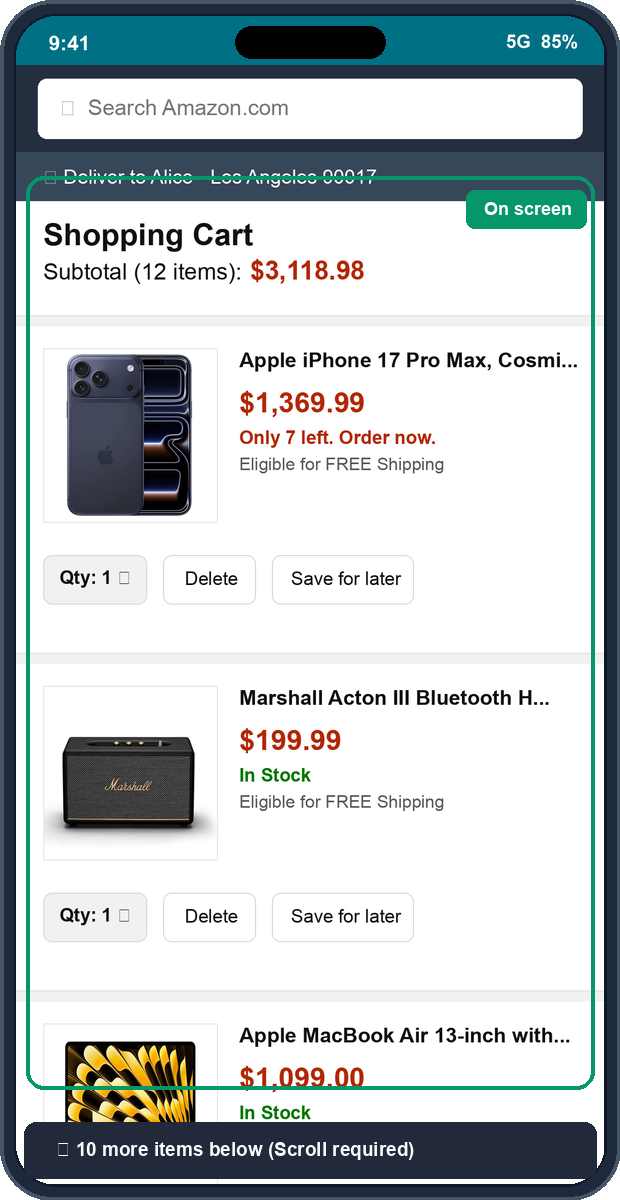
- Inspect the full cart Inspect every item, including those below the current screen.
- Rank across the list Compare candidate prices across the list.
- Add their prices Return the combined price of the three highest-priced items.
Expected top-three total
Examples of reported answers
The Dyson vacuum appears later in the cart and belongs in the top three. An agent has to retain candidates as they leave the screen, compare them with later items, and establish that it has reached the end. The paper identifies incomplete enumeration as one source of failure: correct arithmetic still gives the wrong answer if the set of items is incomplete.
In a separate successful task in Appendix K, the agent searches for the cheapest electronics item, scrolls to the bottom, and confirms it has seen all 12 items before choosing the Marshall Acton III at $199.99; the evaluator accepts its name and price.
Reading the numbers is only the first step
A misread price would corrupt every later comparison or calculation. To check this step, reviewers manually inspected 1,287 execution steps from failed JD numerical tasks across three agents. They found one reading or extraction error (0.08%).
In these audited runs, reading the values was rarely the step that failed. The next problem is using those values across the task: choosing the right inputs, retaining candidates from earlier screens, and applying the requested cutoff. A price can be read correctly and then compared against the wrong threshold.
Numerical tasks and reading audit
The suite contains 183 numerical-reasoning tasks covering counting, arithmetic, comparison, and threshold filtering. The best reported scores are 52.31%, 57.78%, 52.00%, and 42.86%, respectively. Most models score below 15% on threshold filtering.
Threshold filtering has the lowest leading score
Claude-Opus-4.7
GPT-5.5
Claude-Opus-4.7 / GPT-5.5
Claude-Opus-4.7
Reviewers compared each value read by the three agents with the value displayed on screen. The table records failed tasks, execution steps inspected, and reading or extraction errors in the JD simulator.
Perception errors in failed JD tasks
Scroll horizontally to see all columns.
| Agent | Failed tasks | Steps audited | Read / extraction errors |
|---|---|---|---|
| Claude-Opus-4.7 | 17 / 27 | 284 | 0 (0%) |
| GPT-5 | 20 / 27 | 443 | 0 (0%) |
| Gemini-2.5-Pro | 25 / 27 | 560 | 1 (0.18%) |
| Total | — | 1,287 | 1 (0.08%) |
When more actions stop helping
Across the evaluation, 2,036 runs reach the 50-step limit. Only nine succeed (0.44%).
At the action limit
2,036 runs reached the 50-step limit
Task outcomes
Repeated action patterns
Repetition: at least three consecutive actions with the same normalized pattern.
A repeated swipe can reveal more of a list. Tapping a non-interactive area can leave the screen unchanged. An agent needs to distinguish continued inspection from stalled progress and change its plan when the current action stops helping.
Success and action efficiency
Of the runs that reach the step limit, 1,690 (83.01%) contain at least three consecutive repetitions of the same normalized action pattern.
Less successful agents tend to use more actions and exhaust the budget more often. Across the 19 agents, overall success correlates negatively with average valid actions, action overhead, and budget exhaustion. The relationship is weakest for action overhead: GUI-specialized systems can produce short trajectories on the tasks they solve while leaving many other tasks unfinished. A repeated swipe can be useful if it reveals new items. To spot a stalled run, an agent also needs to notice whether its actions change the screen or advance the task.
Success and efficiency move together
Average valid actions
Pearson -0.669 · Spearman -0.657
Action overhead
Pearson -0.458 · Spearman -0.355
Budget-exhausted runs
Pearson -0.705 · Spearman -0.699
What to test next
Reading each visible value correctly still leaves work to do. An agent must inspect the relevant list, keep its constraints in force, and change course when it stops making progress. AppSim-Bench gives researchers repeatable tasks on which to test those behaviors.
The simulators implement the task-relevant parts of each app with defined data. Live content, account histories, network behavior, and broader cross-app workflows remain important areas for complementary evaluation.
Next, we can test whether tracking list coverage and checking for the end of a list improves ranking tasks. We can also test recovery rules for repeated actions that leave the screen unchanged. Running each version from the same starting state with the same 50-step budget lets us compare it with the original agent.
The work is published in the EMNLP 2026 Main Conference proceedings. The paper and project resources include the evaluation framework, tasks, and links to the 17 simulator repositories and APK releases. We invite researchers to build on these environments and investigate the workflows that remain unsolved.
Citation
Please cite the paper as:
Jintian Feng, Long Chen, Xiao Yu, Jiayi Dai, Chenglong Liu, Haoru Wang, Zizhen Xue, Yuxuan Shi, Ziyang Wang, and Yichen Gong. 2026. AppSim-Bench: Bridging Real-world Apps and Reproducible Evaluation for Mobile GUI Agents. In Proceedings of the 2026 Conference on Empirical Methods in Natural Language Processing, pages 36823–36845, Budapest, Hungary. Association for Computational Linguistics.
https://doi.org/10.18653/2026.emnlp-main.1620
Or use the BibTeX citation:
@inproceedings{feng-etal-2026-appsim,
  title = "{AppSim-Bench}: Bridging Real-world Apps and Reproducible Evaluation for Mobile {GUI} Agents",
  author = "Feng, Jintian and Chen, Long and Yu, Xiao and Dai, Jiayi and Liu, Chenglong and Wang, Haoru and Xue, Zizhen and Shi, Yuxuan and Wang, Ziyang and Gong, Yichen",
  editor = "Lee, Hung-Yi and Dev, Sunipa and Li, Junyi Jessy and Elliott, Desmond",
  booktitle = "Proceedings of the 2026 Conference on Empirical Methods in Natural Language Processing",
  month = oct,
  year = "2026",
  address = "Budapest, Hungary",
  publisher = "Association for Computational Linguistics",
  url = "https://aclanthology.org/2026.emnlp-main.1620/",
  doi = "10.18653/2026.emnlp-main.1620",
  pages = "36823--36845",
  ISBN = "979-8-89176-459-0"
}
Citation metadata: ACL Anthology · DOI